
The work was carried out using the author's method of digital analysis of the form of information.
Relevance
The relevance of the work is that in order to prevent disasters and predict catastrophic phenomena, a physical and mathematical theory and device have been created that allow us to determine the component of information related to future events.
Due to the fact that many catastrophic natural and man-made phenomena occur without a statistical and deterministic basis, there is particular relevance in work on discoveries aimed at obtaining accurate information about the future, including ways to prevent disasters.
The work implements the principles of theoretical and instrumental technologies, built on the postulate of general interrelations of all elements of reality (1).
A structural-analytical approach to constructing control systems in which each element performs the task of harmonious development of all elements of reality is defined.
A method for obtaining a substance is shown, based on the allocation of matter by using a mechanism for controlling the area of future events.
Using this technology, single control impulses of the current time can be placed in crystals in such a way that the necessary substance can be obtained at a certain point in the future space and time.
Object of study:
Earthquakes, industrial facilities, any reality with known or unknown parameters.
The scientific novelty of the study consists in the fact that:
The theoretical significance of the work consists of:
The practical significance of the study lies in:
Testing and implementation of results
The testing and implementation of the results were carried out using the author's technology of digital analysis of the form of information allocated for any object on the principle of interrelations of all elements of information (2)
Based on personal experience of precise management of irrational methods and principles of translation of the results of such management into material structures, described in the doctoral dissertation "Applied structures of the creating area of information", numerical data were obtained that determine the correctness of the structural-analytical mechanism of work, including theoretical and practical results.
The source material for the digital analysis of the device's operation in terms of compliance with real processes was the data from monitoring the Earth's surface by control systems from the planet's satellites, provided by the Agency for Monitoring and Forecasting Emergencies (VNII GOChS) of the Ministry of Emergency Situations of Russia.
1. INTRODUCTION
The study of reality processes, taking into account that future events are recognizable in current ones, makes it possible to prevent disasters and manage future events.
The essence of this approach is that future events are viewed from the present in the form of controlled structures (3).
Information about future events is revealed through areas of transition from the future to the present.
The transition regions are constructed on seven coordinates:
three coordinates of the space of the current time,
time coordinate,
two coordinates of time intervals for the past and future, the coordinate of the object's reaction.
The coordinate of an object's reaction in the general case denotes the area of interaction of all information objects, and in the particular case it can denote human perception.
To save an information object from destruction, one can use the transformation of the future time interval through the past time with the projection of data into the three-dimensional space of the current time.
Optical systems satisfy the conditions for signal registration.
The light element, when moving through the optical medium of crystals, is divided into components corresponding to all areas of information.
The component of light, organized as a reflection of future events through an interval of the past, is a point that is infinitely distant from the crystal in its properties, but physically located in it, which allows us to describe the properties of the optical system for recording and decoding future events.
Having, therefore, a fragment of future processes in the current time, it is possible to construct the matter of the future in accordance with the harmonious phase of development and with the necessary precision.
Knowing the distribution of signals from the future in the area of reality control, it is possible to prevent disasters by creating an optical system that harmonizes all areas of information.
It is precisely the light signals that are processed because light has the property of splitting in crystals into components of current and future time.
The physical meaning of this phenomenon in a model form is visible if we consider the properties of light in the time interval

Then the segment of information corresponding to the future time for the time interval
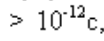
can be considered as an element that is in contact with the segment of information corresponding to the current time.
The boundary of contact between segments of the future and current time can be physically expressed by a crystalline system.
Therefore, the light is divided by the crystalline system into elements of the current and future time.
This means that by setting the parameters of an optical system built on the laws of crystalline structure, it is possible to control matter and create elements of events in the required way.
2. FUNDAMENTAL DEFINITIONS OF OPTICAL SYSTEMS
Fundamental definitions of optical systems are defined in three areas
2.1. The first area is the definition
of information interaction of objects in the future time for the original space and the perception of the current time
2.1.1. Formulation and data of the discovery of energy of the future
The energy of the future is defined as consisting of the energy of the past, multiplied by the space of distribution of the energy of the current time and divided by the space of distribution of the energy of the past

Where
 - energy of the future,
E - energy of the past
W - the space of distribution of energy of the current time,
U - space of distribution of energy of the past
The novelty of the definition of the energy of the future is that for the first time a segment of the energy of future information objects has been identified, which makes it possible to determine the future from the established values.
The scope of application of the definition is implemented in all control systems and optical information conversion systems.
In optical systems built on crystals, the division of light is registered in accordance with the discovery of the energy of the future.
Defining the crystal space in W ,
in U space of the measurement area,
and E as the energy of the elapsed light pulse,
is being output

Based on classification

Depending on the norm of events, a control forecast is established.
2.2. The second area is the definition of past energy.
2.2.1. Formulation and data of the definition of the energy of the past.
The energy of the past is defined as the product of the energy of the current time (the energy of the present)
and the functions of the intersection of the energies of the future and the past

Where
En - the energy of the present,
F - the intersection function of the energies of the future and the past
The novelty of the definition of the energy of the past is that previously unknown phenomena of reality have been discovered, allowing us to determine the energies of all times in one area.
The scope of application of the definition of past energy is realized in systems for recognizing signals from objects located in any reality.
Including in reality with an unknown structure.
In the conceptual direction for infinite quantities F identified with

Signal recognition in the structure of crystalline optical systems is realized by fixing F in the areas of signal interaction between crystals.
2.3. The third area is the definition of shared reality.
2.3.1. Formulation and data of the definition of general reality:
A common reality for all processes has been determined , which consists in the fact that the impulse of any event is transformed into the current time (into the events of the present) from the area of intersection of the future with the past.
In this regard, the reality of any process is transformed in the area of remote and individual content into a reproducible environment,
i.e. any process is as unique as it is often repeated in the area of energy transformation into the present
(in current time events).
Consequently, any element of reality in the transformation phase is indestructible and repeatable under any conditions of the internal and external environment.
This means that any element of reality can be restored.
Therefore, the impulse of the future event contains a solution to the method of preventing disasters.
In formalized form, the discovery formulas are presented in the following form:
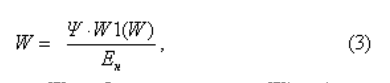
Where
W - common reality,
W 1 is the function of general reality for the recorded phenomena of the dynamics of any environment.
The novelty of the definition of general reality is that for the first time a functional environment has been defined that allows for the transformation and description of any processes of reality from one point.
The scope of application of the definition of general reality in optical-conductive systems allows us to isolate the transforming impulse of any environment and control reality.
In general, discovery determines all phenomena of reality.
3. CONSEQUENCES AND GENERALIZATIONS OF DEFINITIONS
The consequences of the fundamental definitions of optical systems are that the laws of the control optical pulse are realized in practice.
The first law is that crystal-based optical systems are reproducible as reflections of future events through picosecond intervals of the past.
The second law consists of the movement of the optical signal both in the direction of the fixing systems and in the environment of undetermined properties.
In this regard, it is possible to identify an information constant that determines the control of environments with unknown structures.
The third law is that the adoption of the projection area of the future onto the present as the basis for the difference in momentum for different environments determines the structure of the device that harmonizes all systems.
The fourth law is that a system defined by an optical signal is always defined for infinite series processes.
The conclusion of the fourth law is that all processes of reality are described in each of its areas.
That is why the world reacts to changes when there are no more changes in the world.
There is only eternity, which contains itself.
The further conclusion is that the eternity of the crystal is a reflection of the ongoing reality.
By generalizing the fundamental definitions of optical systems, the mechanism of connection between the formal apparatus of discoveries and the reproducible phenomena of the external and internal environment is determined.
The generalization of the discovery of the energy of the future allows us to determine the future in the reflection of a segment of future events in an environment that has significant temperature differences or the type of crystalline system.
Detailing of the phenomena of reality with the simultaneous socialization of the control environment leads to wave synthesis systems.
The essence of the wave synthesis system in the description of reality processes is that reality is considered as a periodic intersection of stationary regions with dynamic ones.
In the area of intersections, a synthesis of the dynamic wave of reality with the stationary one arises.
By identifying the dynamic phase in the stationary region, infinite functioning of the stationary region is achieved.
In crystals, a similar process allows, by solving the inverse problem, to obtain from a stationary medium (from a crystal) a dynamic component of wave synthesis, i.e. a time phase.
The theory of wave synthesis in the description of reality is formally expressed as follows:

Where
T - time,
Y - the wave of the dynamic phase of reality,
S - stationary phase of reality
In a certain case, the wave synthesis of reality can be imagined as an infinite wave periodically passing through stationary areas and creating new phases of reality from the processes of intersection.
Fixing the component of the dynamic phase in the stationary phase allows making the stationary phase independent of time, in fact eternal.
Consequently, for such a region the created object is eternal, and therefore always recoverable (4).
Considering earthquakes from the indicated position, it is possible to find the criterion of the recoverability of the measurement environment over time through reflections on the crystal faces.
This criterion allows us to accurately determine the time of occurrence of the earthquake.
For man, the theory of wave synthesis proves immortality.
To achieve immortality, it is necessary, in accordance with the theory of wave synthesis, to transfer the area of reproduction of the stationary phase of reality S into the wave of the dynamic phase of reality Y.
One of the indicators of such a translation is the reproduction of genes from human thought forms.
Therefore, in optical earthquake recognition and control systems, the potentially eternal “human” system interacts with the crystal system in the area of stationary phase reproduction.
This interaction not only predicts an earthquake, but also harmoniously reduces its strength.
An earthquake of reduced strength is already registered.
This means that the earthquake prediction device built on the optical medium has the function of harmonic reduction or complete prevention of earthquake.
Moreover, information about a failed earthquake is not reproduced anywhere else and even increases the life of the device.
In this case, the potential eternity of a person actually reproduces the resource of the device.
The eternal gives birth to the eternal.
In a general sense, all devices and mechanisms reproduced by man must satisfy the described conditions.
Then, according to the principle of feedback, these devices and mechanisms will always be creative for humans and under no circumstances will they destroy not only humans, but also the environment.
To build such technology, it is necessary to translate the laws of propagation of optical signals into the design and principles of operation of technical systems.
4. RESEARCH AND ANALYTICAL SYSTEMS OF OPTICAL MEDIA IN THE IMPLEMENTATION OF EARTHQUAKE AND DISASTER PREVENTION
Research into optical media in the direction of the phase separation of an optical pulse is carried out according to the principle of minimizing the resistance of the medium along the pulse trajectory.
In a particular case, this means identifying the motion vector along which the absorption coefficient is minimal.
In the system of general connections, by which each object interacts with all others, including objects of the future and the past, the optical element of the current time divides the light pulse into three phases of time.
According to the theory of wave synthesis, the current time can be considered as a dynamic wave.
Time of the past as a static area,
the time of the future as a synthesized phase of reality, constructed by fixing a static area in a dynamic wave.
The creation of a known substance occurs through a static region, and the unknown in the initial period of the synthesis of the future reality.
For optical systems, the event part corresponding to time for the past is defined as an optical medium of fixed characteristics (for example, a crystal) for the current time by a light pulse, for the future by a synthesized region arising from the interaction of a light pulse and a crystal.
According to the specified distribution, the formula for the energy of the future is
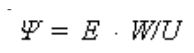
means that future events based on future energy

is determined by a fixed value
elapsed light pulse E
under conditions where U denotes the space of the optical system
and W is the space of the optical system and measurement areas.
Considering that according to the formula
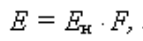
The energy of the present E n
is determined by the current (changeable ) value of the light pulse,
you can find the function F as a projection of the measurement areas
on the analytical system of optical media.
The analytical system of optical media is located in the space P , which contains an optical medium containing changing areas of intersection and reflection of light pulses.
Using what is in the formula of general reality
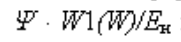
it is possible to determine the characteristics of phenomena from one point,
located
W 1 ( W ) for the space P in the form of a projection of the measurement areas onto P .
Taking into account W in the measurement method, the optical environment first creatively and harmoniously redefines reality to reduce the strength of an earthquake or prevent an earthquake.
In general, using the expression for W , one can transform information about any disasters into reduction or prevention.
According to the law of general connections between all phenomena of reality, the results obtained for optical systems can be translated into any environments that have similar functions.
It follows from this that measurements and prevention of catastrophic phenomena of reality can be carried out from any point in reality.
If the control forecast of reality phenomena, consisting of reducing or preventing disasters, is constructed by means of a device based on an optical system, then the functions of the device are determined by the criteria of light impulses.
5. STRUCTURAL-ANALYTICAL INSTRUMENTS FOR PREVENTING EARTHQUAKES AND DISASTERS
By applying the structure of optical systems obtained in this work, which allows for the harmonious prediction and prevention of disasters, it is possible to construct devices whose use does not cause negative consequences in any time or space (5).
A catastrophe prevented or reduced in strength by such devices will never happen again.
According to this principle of harmonization, technology and any created objects should be built.
This technique is safe for the manufacturer and the environment.
Crystal module for earthquake and disaster forecasting. Functions of the module for creating matter
Earthquakes can be predicted in a time interval of up to seven days using oriented crystals. The arrangement of rock crystal crystals, the chemical composition of which is quartz, the crystal system is trigonal, the hardness is 7.0, the specific gravity is 2.65, the refraction is
1.54-1.55, birefringence 0.009, in projections along the coordinate planes is as follows:
by the ZOX region ( OX is the horizontal axis, OZ is the vertical axis):

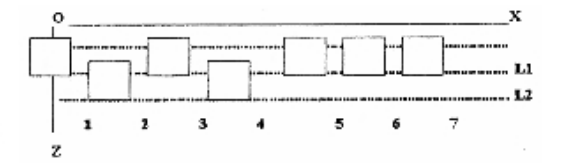
The arrangement of crystals is shown in the diagram.
Each crystal is a cube with a side length of 3 cm.
The cubes are located on a plane, ZOX .
Cubes 1,3,5,6,7 are located with one side on line L 1, and cubes 2 and 4 are located on line L 2.
The distance between the lines L 1 and L 2 is 1.5 cm, and they are parallel to the OX axis .
The distance between crystals 4 and 5 is 2 cm, and between the others 1 cm.
The crystals are located in a transparent sphere.
The characteristics of the crystals and the sphere must satisfy the conditions for separating the light pulse from the terrain map into two projections.
The condition for dividing a light pulse includes the principle of amplifying its projections due to signals reflected from surfaces.
The principle of this device is based on the fact that when light is transformed in a special optical environment, the shape of the light volume corresponding to future events is selected.
The arrangement of the crystals is chosen so that earthquakes and disasters are prevented and the creative development of the future is harmonized in plus or minus infinity.
The normalization of the output radiation occurs in accordance with the fact that, according to the formula of general reality, the intersection of the components of light with the harmonic level of crystals causes normalization in the processes of reality.
This device is built with the implementation of the concept of creative properties of any technical device.
The output characteristics of the light allow obtaining information about the time and strength of the earthquake for a period of seven future days.
For a device in which the material of the crystal cubes is rock crystal, the surfaces of the cube must be as flat as possible, with a processing accuracy of up to a micrometer.
Absorption of a monochromatic wave of length by a surface
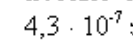
per nanosecond pulse should be equal to 0.5 with a map reflectivity of 0.62.
Surface properties must be changed at time periods corresponding to the service life of the device.
The resource of this device is nine months.
The resource of the device can be increased many times by adding an external optical lens to the device.
The lens position change will need to be calculated every 5 months after the first nine months of using the device.
After the first three five-month periods, three four-month periods are calculated, and so on up to ten-day periods.
Next, you need to change the shape of the lens.
The output parameters are recorded by measuring the light characteristics from the side of the sphere opposite to the map or terrain.
If the light characteristics change by more than 25% per millisecond in the measured area, earthquakes with a magnitude of three points at the epicenter should be profiled 14 days after the moment of registration.
The epicenter of an earthquake is determined by scanning segments of the measured area.
At the epicenter, for the given case, the characteristics of light change by 32% per millisecond.
For production facilities, the entire production operation scheme is measured.
If the light characteristics change by more than 14% per millisecond in the measured area, deviations from the norm should be profiled 14 days after registration.
Detailing of a process that may have deviations from the norm is carried out by increasing the scale of a localized section of the diagram and the following measurement.
In the circuit element that is causing the deviations from the norm, the light characteristics change by 32% per millisecond.
In general, by schematizing any phenomenon of reality, one can obtain a control forecast of events by measuring with such a device the schemes corresponding to reality.
Since the event management may require the creation of a substance with specified characteristics (for example, urgent restoration of a microprocessor in a falling airplane), the device can be specifically oriented towards this process by placing the substance diagram (the microprocessor diagram for the given example) above the third crystal of the module.
The use of a mechanism for creating the necessary substance by applying the principles available in the crystalline module allows for the creation of new environmentally friendly production facilities.
The calculation of the device characteristics and measurement surfaces for some processes is carried out using one method, while in other processes a new method is developed for each calculation.
In certain cases, when the schematization of a phenomenon does not fully reflect the parameters of the phenomenon required for measurement (for example, for fast-moving, microprocesses or some global catastrophes ), irrational possibilities for determining the design data of the device are used.
Due to the fact that any phenomenon of reality, including the unknown, can be schematically described, such a device allows one to determine, with simultaneous prevention, catastrophic processes from unknown areas of reality.
6. OPTICAL SYSTEMS IN MICROPROCESS CONTROL
In accordance with the theory of wave synthesis, control of microprocesses in an optical system occurs in the synthesis region.
In microelectronics, the application of fundamental definitions of optical systems occurs on a multicomponent basis.
Each component can be defined by several parameters.
The parameters that define the components can also be functionally interrelated.
According to the laws of quantum mechanics in an elementary volume

momentum P -space of quantum states contains
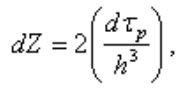
Where

- Planck's constant cubed
Considering that the isoenergetic surfaces in P -space are represented by spheres, it is possible, on the basis of the theory of wave synthesis, to control the number of quantum states N ( E ), by the method of transforming the form of information corresponding to the effective mass of an electron near the bottom of the conduction band

into the control pulse of the optical system.
For this purpose, the necessary transformation parameters are located above the fourth crystal.
This technology could move the design and manufacturing of molecular devices towards complete environmental safety.
7. CONCLUSIONS
Based on fundamental definitions of optical systems, data were obtained for constructing a device for preventive forecasting of disasters.
The disaster prediction device, built on the basis of light flow analysis, has the functions of harmoniously reducing or preventing disasters.
In such a device, correction is made to maximally reduce the parameters of the disaster and determine the characteristics of the phenomenon.
According to the law of universal connections, such instrumental and analytical structures are not dangerous for humans and the environment, since they are implemented on the safe characteristics of light.
By using the control component of the optical system, it is possible to create the required reality.
The fundamental definitions of optical systems have the following expressions:
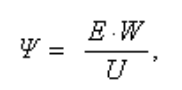
Where

- energy of the future,
E - energy of the past,
W - the space of distribution of energy of the current time,
U - space of distribution of energy of the past
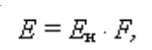
where E n is the energy of the present,
F is the intersection function of the energies of the future and the past.
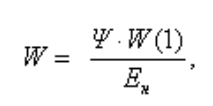
Where
W - common reality,
W 1 is the function of general reality for the recorded phenomena of the dynamics of any environment.
The novelty of the definition of general reality is that for the first time a functional environment has been defined that allows for the transformation and description of any processes of reality from one point.
The scope of application of the definition of general reality in optical-conductive systems allows us to isolate the transforming impulse of any environment and control reality.
In general, discovery determines all phenomena of reality.
The consequences of the fundamental definitions of optical systems are that the laws of the control optical pulse are realized in practice.
The first law is that crystal-based optical systems are reproducible as reflections of future events at picosecond intervals of the past.
The second law consists of the movement of the optical signal both in the directions of the fixing systems and in the environment of undetermined properties.
In this regard, it is possible to identify an information constant that determines the management of environments with unknown structures.
The third law is that the adoption of the projection area of the future onto the present as the basis for the difference in momentum for different environments determines the structure of the device that harmonizes all systems.
The fourth law is that a system definable by an optical signal is always definable for infinite series processes.
The conclusion of the fourth law is that all processes of reality are described in each of its areas.
The theory of wave synthesis has been obtained.
The theory of wave synthesis in the description of reality is formally expressed as follows:
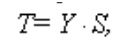
Where
T - time,
Y - the wave of the dynamic phase of reality,
S - stationary phase of reality
Research into optical media in the direction of the phase separation of an optical pulse is carried out according to the principle of minimizing the resistance of the medium along the pulse trajectory.
By applying the structure of optical systems obtained in this work, which allows for the harmonious prediction and prevention of disasters, it is possible to construct devices whose use does not cause negative consequences in any time or space.
A catastrophe prevented or reduced in strength by such devices will never happen again.
Technology and any created objects should be built according to this principle of harmonization.
This technology is safe for production and the environment.
The earthquake forecasting crystal module is built on this principle.
In general, by schematizing any phenomenon of reality, one can obtain a control forecast of events by measuring with such a device the schemes corresponding to reality.
For a number of reality processes (for example, fast-moving, microprocesses or some global catastrophes), the calculation of the device parameters is carried out using sensory capabilities, taking into account the understanding of the laws of general connections.
An irrational approach to calculating the parameters of a device allows one to obtain the functions of the device for analyzing and determining unknown properties of reality.
Application
Methods of quantitative calculation of the crystalline module of preventive forecast of earthquakes and disasters
Introduction
To obtain a quantitative calculation, it is necessary to consider the entire process of the device operation and establish the boundary and initial conditions for all intermediate cycles of the process.
By dividing the problem into the process of light passing through the device and the process of measuring the output characteristics, it can be established that one of the sources of obtaining output information is measuring the temperature in the crystal region.
The application of the theory of wave synthesis shows that the area of the static wave of reality in calculations can be supplemented by the area of the dynamic wave of reality, and from the area of reproduction of reality, the characteristics necessary for measurement can be found.
In this particular case, we denote by the region of the static wave of reality S the radiation emanating from the measurement region, located on the side of the measurement object and attached to the device.
Then the earthquake time T in accordance with a fixed scale can be determined taking into account the effect of laser radiation on the measurement area of the device's output parameters.
Laser radiation, in accordance with the theory of wave synthesis, enhances the informative parameters of perceived light radiation.
The process of exposure of laser radiation to the structural material of the product must be oriented depending on the characteristics of the radiation from the measured object.
The study of the impact process is necessary, first of all, to justify the structural materials used in the product and to issue recommendations for further design.
The complexity of the study is due to the dependence of the nature of the process on the thermophysical characteristics of the material and the energy characteristics of the laser radiation.
For each specific case of interaction of laser radiation with a material, a completely specific mathematical model of the process must be constructed, describing the real physical process, under assumptions that do not violate the adequacy of the model to the real physical process.
Many original articles, reviews and monographs present mainly solutions to particular problems with a number of limitations characteristic of a given interaction model.
Therefore, there was a need to construct mathematical models of interaction with specific materials.
The construction of a mathematical model that accurately describes a physical process, in my opinion, should be accompanied by experiments.
Based on this, a computational and experimental method of solving the problem was used, for which digital modeling was applied, allowing information objects to be translated into geometric form.
Thus, the device is a crystalline module, the first crystal of which is directed towards the measured object, and a thermocouple is attached to the wall of the last crystal.
Measuring the output characteristics through a thermocouple is one of the sources of information.
The advantages of such a source are increased noise immunity.
The use of laser radiation by applying the theory of wave synthesis also solves the problem of the stability of the signal emanating from the measured object.
Since the radiation emanating from the measured object for the variant of measuring characteristics through a thermocouple is a particular task of the laser radiation process, it is clear that the main thing is the calculation of the laser radiation process.
1. Interaction of continuous laser radiation with materials
1.1. Heat propagation in a homogeneous layer of substances
The thermal state of the irradiated material and the nature of the physical processes are determined by the energy characteristics of the laser radiation, the flux density and the time of exposure to laser radiation, the spatial distribution of the intensity along the beam and its geometric parameters, and the thermophysical characteristics of the irradiated material.
The energy of laser radiation E concentrated on the surface of the irradiated material is distributed as follows:

Where
E o тре - energy that is specularly and diffusely reflected by the irradiated surface,
E absorb - laser radiation energy absorbed by the material,
E prop - laser radiation energy transmitted by the material ( for transparent materials )
Only the absorbed portion of the energy was taken into account.
In this work, the heating of materials is calculated using the classical theory of thermal conductivity.
The rationale behind this approach is that light energy is instantly converted to heat at the point where the light is absorbed.
The energy is distributed so quickly that local equilibrium exists throughout the entire exposure time.
Therefore, we can use the concept of temperature and the usual equations for heat flow.
In practically interesting cases we can consider the problem to be one-dimensional.
This is possible when the transverse dimensions of the laser beam are large compared to the depth to which heat spreads during the action of the laser radiation, and when the model of heat propagation in an inhomogeneous layer of matter, which is described below, can be used to calculate the propagation of heat in other directions.
To clarify the characteristics of the spatial distribution of radiation, it is possible to use the principle of integration of distributed temperatures, which, however, is not necessary, since using the theory of wave synthesis it is possible to obtain the necessary number of clarifications at any point of the process according to the method of static and dynamic phase of reality indicated in the introduction, based on fundamental discoveries of optical systems.
We will assume that the distribution of the laser radiation intensity in the beam is uniform and cylindrical.
We will assume that the absorption coefficient of laser radiation A depends on temperature.
The differential equation describing the propagation of heat in a homogeneous layer of matter has the form:
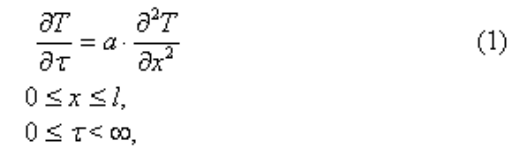
Where
T - temperature,

time,
x - space,
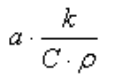
- thermal diffusivity coefficient,
k - thermal conductivity coefficient,
C - specific heat capacity,

- density
l - thickness of the layer of substance
Initial condition:

Boundary condition on the irradiated surface:
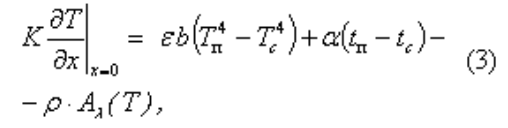

- irradiation coefficient,
b - Stefan-Boltzmann constant
T p - absolute temperature of the body surface
T c - absolute temperature of the environment
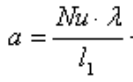
- heat transfer coefficient, where
Nu - Nusselt number,

- coefficient of thermal conductivity of the cooling medium,

- characteristic size of a unit area

- body surface temperature,

- temperature of the cooling medium.
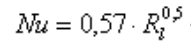
- in the laminar flow mode of the cooling medium,
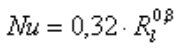
- in turbulent flow conditions of the cooling medium,
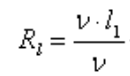
- Reynolds number
(at


- the flow regime of the cooling medium will be laminar)
Where
v - kinematic viscosity of the cooling medium

- laser radiation flux density
Boundary condition on the back surface:

Boundary condition in the presence of thermal insulation on the rear surface:

The system consisting of the differential equation of heat conduction (1), the initial condition (2) and the boundary conditions (3), or (4*), is a mathematic model of the process of interaction of laser radiation with a material.
Such a nonlinear problem presents significant difficulties even for solution by numerical methods.
Since terms containing quarter powers of temperatures strongly influence the stability of difference schemes, and control of the scheme convergence requires significantly more computer time.
To solve the problem numerically, we will use the grid method using an explicit first-order difference scheme.
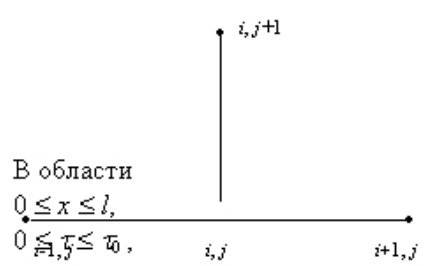
Where

- the time of exposure of the material to laser radiation,
let's introduce a grid

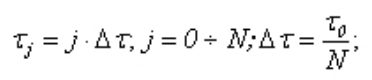
Where
h - increment of spatial coordinate,

- increment of the time interval,
M is the number of spatial breakdown nodes,
N is the number of time breakdown nodes.
Then the finite difference approximation of equation (1) can be written as:
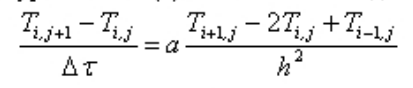
Let
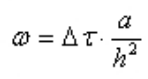
Then

The finite difference approximation of equation (2) has the form:
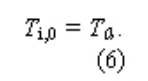
The finite difference approximation of equation (3) can be written as:


Where



The finite difference approximation of equation (4) has the form:

Equations (4*):

The convergence of the constructed difference scheme can be ensured by varying

In this case, it is necessary to find the optimal value from the point of view of saving machine time.

ensuring the convergence of this difference scheme.
In each specific case, depending on the thickness of the material, the time of exposure to laser radiation and the thermal properties of the materials, it is advisable to determine its own value.

1.2. Heat propagation in a heterogeneous layer of matter
In the device, the intermediate medium between the crystals determines the extension of the calculation method to layered materials, characterizing heterogeneity in various directions.
The diagram of such materials is shown in Fig. 1.
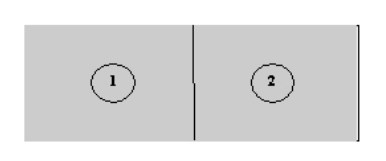
Fig.1
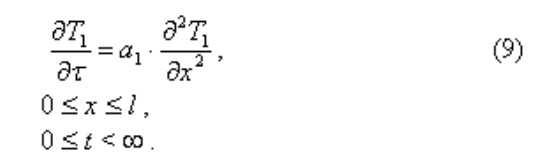
The differential equation describing the process of heat propagation in layer 1 is:
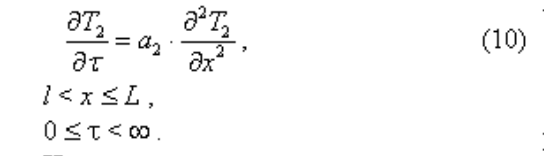
For layer 2 we have:
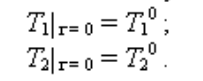
Initial conditions:
The boundary conditions on the hoop and back surfaces of the material are similar to the boundary conditions in paragraph 1.
The boundary conditions in the area of contact of the layers, provided that the thermal contact is ideal, have the form:
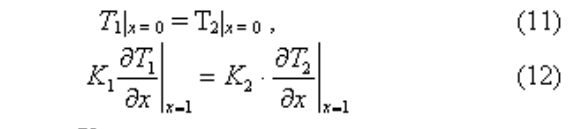
Finite difference approximation of equation (11):

Finite difference approximation of equation (14):
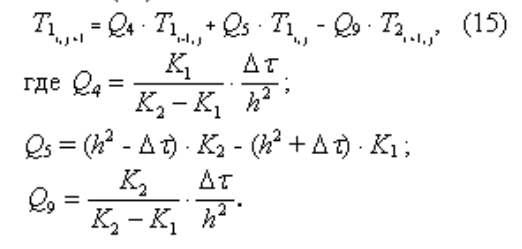
The obtained result can be easily transferred to a multilayer model of the material.
Cyclic calculations using the obtained finite difference formulas describe the process of non-stationary thermal conductivity in the material.
Initially, in accordance with the initial conditions, an initial assignment is made:

Where
N - number of layers of material.
In addition, the dependence of the absorption coefficient of the material on the surface temperature should be taken into account.
The absorption coefficient will be determined according to experimental data.
The constructed mathematical model is applicable before the material begins to melt.
2. The effect of pulse-periodic laser radiation on structural materials
To increase the service life of the device and reduce the requirements for processing crystal surfaces, it is possible to use pulse-periodic laser radiation.
When constructing a mathematical model of the process of interaction of pulse-periodic laser radiation with a material, one should first of all consider the possibility of replacing pulse-periodic radiation with quasi-continuous radiation.
Let

- interval between pulses,

- pulse duration
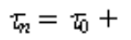

- pulse repetition period.
If

- time of exposure to radiation,
then the conditions for replacement with a quasi-continuous process have the form:

If condition (16) is not satisfied, i.e. the pulse-periodic process of the effect of laser radiation on the material is not approximated by quasi-continuous, then the determinism of the components of the pulse-periodic process is taken into account.
At the initial moment of time after the cessation of the pulse action, the isotherm with a fixed temperature moves into the depth of the material, and then, after reaching a certain depth, the reverse movement of this isotherm takes place.
The position of the isotherm at the beginning of the next pulse allows one to determine the depth of heating of the material.
Thus, the solution obtained for continuous exposure to laser radiation is generalized to the case of pulse-periodic nature of laser radiation, where the duration of the pulse is taken as the duration of the exposure process

In cyclic calculations during the quantitative implementation of finite difference equations, the cooling regime is specified by eliminating the term
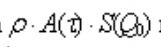
from equation (7) for time

(corresponding to the interval between pulses),
and received after the expiration of time

the set of temperatures in the calculation nodes is taken as the initial one for the heating mode.
The heating mode is specified by including in equation (7) the term

for the duration of the impulse

When describing the effects of millisecond laser pulses with a radiation flux density of up to
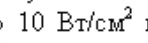
on optical surfaces it should be taken into account that:
- energy losses due to re-radiation and convection from the heated surface can be taken into account using a model of a conditionally moving boundary of the absorbing surface;
- the thermophysical formulation of the problem in accordance with the theory of wave synthesis, which describes the interaction of laser radiation with the radiation of the source and the material, is valid only for flux densities that do not cause a change in the optical characteristics of the device until the end of its service life.
3. Conducting experimental work
The results of experimental work carried out with the experimental setup were used to correct the coefficients for converting information objects into geometric shapes.
Then, the functional parameters of the forms were established and modeling was carried out aimed at predicting real earthquakes.
The output information can be measured using a thermocouple, optical signal indicators, etc.
The purpose of conducting experimental work on the experimental setup is to determine the dependence of the temperature of the back surface of the irradiated sample of material on the time of exposure to laser radiation with a given density.

The following were used as the means for conducting the experiments:

Fig.2
O - sample of the material being studied.
The diagram of the experimental setup with the test sample and measuring instruments is shown in Fig. 3.
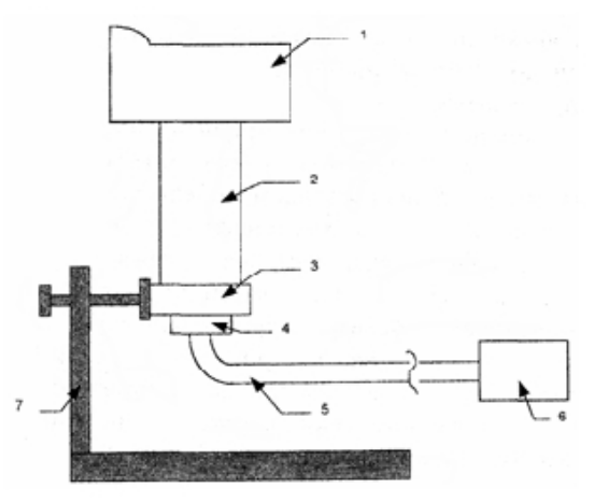
Fig.3
1 - EU, 2 - beam, 3 - material sample, 4 - sensor, 5 - thermocouple wires, 6 - voltmeter, 7 - clamp for fixing the material sample
In installation 1, a laser beam 2 with a certain flux density is generated.

Beam 2 encounters on its way a sample of material 3, fixed on clamp 7.
Thermocouple 5 is attached to the back surface of sample 3.
From thermocouple 5, thermocouple wires 6 go to voltmeter 7.
The voltmeter readings are recorded at certain intervals.
Then, using a special table, they are converted into temperatures corresponding to given moments in time.
The main sources of errors in temperature measurement are violations of the homogeneity of the material layer due to the introduction of a thermoelectric converter into it, as well as the removal of heat through its wires.
The nature of the temperature field test when making a groove for placing a temperature sensor is shown in Fig. 4a, 6.
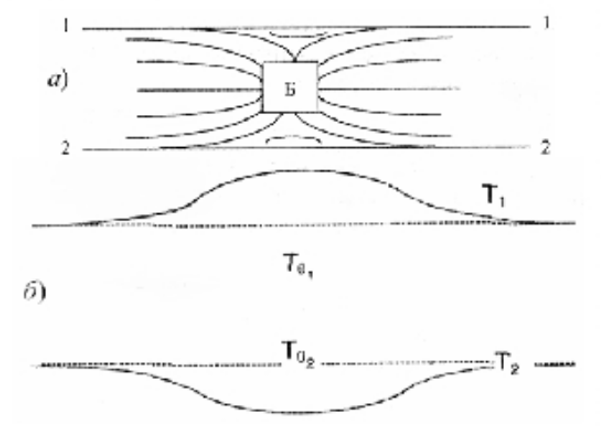
Fig.4
a - isotherms, b - surface temperatures,
1 - 1 and 2 - 2
It is practically impossible to determine the exact point of contact between the thermoelectric converter junction and the groove surface, which results in uncertainty in temperature measurement in the range
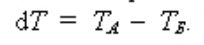
The total measurement error was 4%.
The graphs of the dependence of the back surface temperature on time were constructed as follows:
After obtaining a graph of the dependence of the temperature of the back surface of the sample on time, a numerical calculation of the inverse mathematical model problem was performed.
If the experimental results differed by more than 9% from the results of the numerical calculation, the absorption coefficient value was adjusted.
Thus, it is possible to find the dependence of the absorption coefficient A on temperature for each of the studied materials.
The use of the dependences of absorption coefficients on temperature for these materials allows one to determine the temperature fields of the materials under study with sufficient accuracy for engineering calculations (up to 9%), using only a mathematical model.
When describing the process of interaction of laser radiation with structural materials in a vacuum, the mathematical model is simplified, since the term is excluded from equation (3)
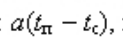
characterizing convective heat transfer.
For preventive earthquake forecasting, the source of radiation is a map of the area.
For preventive forecasting of disasters at industrial facilities, the radiation source is a diagram of the industrial facility with a description of technological cycles (in this case, the device records changes in a specific section of the diagram).
The device's action can be applied to any objects in reality, including objects with unknown properties.
For this, the thermal diffusivity coefficient should be taken as the static phase of reality, and the radiation coefficient as the dynamic phase of reality.
CONCLUSION
The solution is applicable to any disasters, including disasters from environments with unknown properties.
The algorithm for calculating temperature fields using the found finite-difference formulas is shown, as well as ways to optimize the algorithm from the point of view of saving machine time.
The results obtained from the use of the theory of wave synthesis and fundamental discoveries of optical systems make it possible to describe a real physical process both in a gaseous medium and in a vacuum with sufficient accuracy for engineering calculations.